Summary
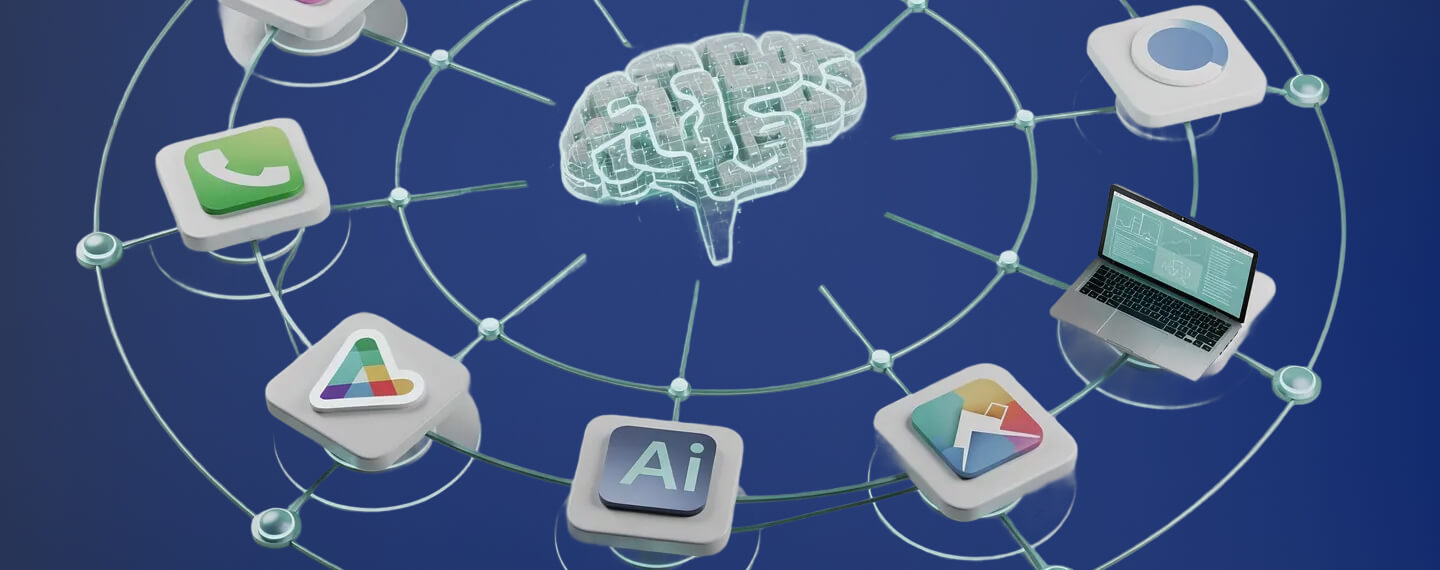
AI agents are software processes that connect your existing business tools, automate the manual tasks between them, and run workflows end to end without human intervention. They don’t replace your software stack. They make it work the way it was supposed to. This guide explains what agents actually are, what they can do for mid-market UK businesses, how much they cost, and how to identify where to start.
Introduction
There is a lot of noise about AI in business right now. Most of it is about chatbots, content generation, and assistants that answer questions. That’s useful, but it’s not where the real operational value lies for most mid-market businesses.
The bigger opportunity is AI agents.
Not because they’re new or exciting, but because they solve a problem that almost every business with more than 20 people has: too many software tools, not enough integration between them, and too much human time spent bridging the gaps.
The average UK mid-market business runs between 8 and 15 SaaS tools simultaneously. Most of those tools have APIs. Most of those APIs don’t work together as cleanly as the vendors claim. The result is a significant amount of your team’s time going into tasks that should be automated: copying data from one system to another, triggering processes that should trigger themselves, pulling reports that should update automatically, and chasing status updates that should already be visible.
AI agents fix this. Not by replacing your software, but by connecting it properly and automating the processes between it.
This guide explains how.
What AI agents actually are
The term “AI agent” gets used loosely, so it’s worth being precise.
An AI agent is a software process that monitors for specific conditions, makes decisions based on rules or learned behaviour, and takes actions across one or more systems automatically. Unlike a standard automation or API integration, which simply moves data on a schedule, an agent actively watches, decides, and acts.
The key distinction is autonomy. A standard integration says “every hour, sync contact records from system A to system B.” An agent says “when a lead from a specific industry with a company size above a certain threshold opens an email and visits the pricing page, enrich their record, add them to the hot leads pipeline, notify the account manager, and schedule a follow-up task for tomorrow morning.”
That’s not a scheduled sync. That’s a process that used to require a person, now running automatically.
Agents can be simple (a single trigger, a single action) or complex (multiple triggers, multiple decision points, actions across five different systems). The most valuable applications are usually somewhere in the middle: a clearly defined business process that currently requires manual steps, automated end to end.
Why now
AI agents are not entirely new. Basic automation tools like Zapier and Make have existed for years. What has changed is the intelligence layer.
Traditional automation is brittle. It breaks when data formats change, when an API updates, when an edge case appears that wasn’t anticipated. It requires constant maintenance and can only handle exactly the scenarios it was explicitly programmed for.
Modern AI agents are more resilient. They can handle variation in data, interpret context, make judgement calls within defined parameters, and adapt to edge cases without breaking. They can read unstructured content (like an email), extract relevant information, and take appropriate action, something that rule-based automation simply cannot do.
The other thing that has changed is cost and speed of deployment. Building a reliable, production-grade agent layer used to require significant engineering resource and months of development time. AI-accelerated engineering has compressed that to weeks, making the investment case compelling for businesses that are not enterprises.
Real use cases by sector
The best way to understand what agents can do is to see them in the context of specific business processes. Here are common use cases across the sectors where we see the most demand.
Sales and CRM
The most common agent use case for sales teams is lead enrichment and routing. A new lead enters your system (from a web form, an outbound tool like Apollo, or an inbound source). An agent automatically enriches the record with company data, scores it against your ICP criteria, routes it to the right team member, adds it to the correct pipeline stage, and triggers a personalised first-touch sequence. What used to take a sales development rep 20 minutes per lead happens in seconds.
A related use case is pipeline hygiene. Agents monitor for deals that haven’t been updated in a defined period, send reminders to the account owner, flag stale opportunities to management, and automatically archive deals that meet inactivity criteria. Sales managers get a cleaner, more accurate pipeline without manual reviews.
Field operations and logistics
For field services and logistics businesses, the most valuable agent use cases are around job completion and invoicing. When a job is signed off in a field management system, an agent generates the invoice, sends it to the client, updates the reporting dashboard, triggers a payment chase sequence if payment isn’t received within the defined window, and notifies the finance team. A process that used to involve three people and take 48 hours happens automatically in minutes.
Route and scheduling optimisation is another common application. Agents monitor job completions, cancellations, and new bookings in real time, and automatically adjust schedules and notify field engineers of changes, replacing the manual dispatch coordination that ties up ops teams every morning.
HR and recruitment
Candidate communication is one of the most time-consuming and error-prone manual processes in recruitment. Agents automate the entire communication flow from application acknowledgement through interview scheduling, feedback requests, offer management, and onboarding trigger. When a candidate moves to a new stage in the ATS, the right communication goes out automatically, the right record is updated, and the right people are notified, without a recruiter having to do any of it manually.
Post-offer onboarding is a particularly high-value application. When an offer is accepted, an agent triggers contract generation, sends it for e-signature, notifies HR to begin onboarding, creates the new starter record in the HR platform, sends the new employee their first-day information, and schedules their induction sessions. A process that previously involved multiple handoffs between recruitment, HR, IT, and management happens end to end without manual intervention.
Professional services and agencies
For professional services businesses, project status reporting is a common pain point. Agents pull data from project management tools, time tracking systems, and finance platforms to generate automated client reports and internal management dashboards. Friday afternoon report preparation, which can consume hours of senior time every week, is eliminated entirely.
Client portal updates are another strong use case. When a project milestone is reached, a deliverable is uploaded, or a decision is needed, agents automatically update the client portal, send the appropriate notification, and log the communication in the CRM. Clients stay informed without your team having to manually update multiple systems.
Finance and operations
Subscription and vendor management is an area where agents deliver immediate, quantifiable value. Agents monitor contract renewal dates, send internal alerts at defined intervals, pull current usage data from platforms, and generate renewal assessment summaries for finance and operations leads. The renewals that previously crept up on businesses and defaulted to auto-renewal are now proactively managed.
Expense and purchase order processing is another strong application. Agents extract data from submitted expenses and invoices, validate against policy, route for appropriate approval, and post to the accounting system. What used to require manual data entry and chasing approvals becomes largely automated.
What agents don’t do
It’s worth being clear about the limitations, because the hype around AI can create unrealistic expectations.
Agents are not a replacement for well-designed systems. If your underlying data is messy, your processes are poorly defined, or your tools don’t have adequate APIs, agents will amplify those problems rather than solve them. The best agent implementations are built on top of clean processes and reliable integrations.
Agents are not infallible. They require monitoring, maintenance, and occasional intervention, particularly when upstream systems change or edge cases appear that weren’t anticipated in the original design. The ongoing maintenance cost is real, even if it’s significantly lower than the manual cost of the processes being automated.
Agents are not magic. The value they deliver is proportional to how clearly the business process being automated is defined, and how much human time and error that process currently involves. The clearest path to value is to start with a specific, well-defined process rather than attempting to automate everything at once.
How to identify where to start
The most effective way to identify agent opportunities is to map your manual processes and ask two questions about each one.
First: how many times does this happen per week, and how long does it take each time? A process that takes 20 minutes and happens 50 times a week represents over 800 hours of team time per year. That’s a strong candidate for automation regardless of how simple the task is.
Second: what happens when this process goes wrong or gets delayed? If a missed or delayed manual step causes customer dissatisfaction, revenue leakage, compliance risk, or significant downstream work, the value of automating it is higher than the time saving alone.
Common high-value starting points we see across most businesses:
Lead or enquiry routing and response Invoice generation and payment chasing Job completion to billing workflow Candidate communication and onboarding triggers Report generation and distribution Contract renewal monitoring New client or new employee onboarding sequences
Start with one. Get it working reliably. Then expand.
What it costs
Agent builds vary significantly depending on complexity and the number of systems involved. A focused agent build connecting two or three existing tools and automating a specific workflow typically takes 4 to 6 weeks and costs in the range of £15,000 to £35,000. A more complex multi-system agent layer covering several business processes typically takes 8 to 12 weeks and costs correspondingly more.
The return on that investment is usually visible quickly. A business that saves 20 hours of senior team time per week at a fully loaded cost of £50 per hour is recovering £1,000 per week, which means a £20,000 agent build pays for itself in 20 weeks. Most agent implementations we deliver achieve break-even within 6 to 12 months, with ongoing saving thereafter.
Unlike SaaS subscriptions, the ongoing cost of a deployed agent layer is maintenance rather than licence fees, typically 10 to 15% of the build cost per year. The economics improve over time rather than deteriorating as pricing increases.
How agents and bespoke software work together
Agents and bespoke software replacement are complementary approaches, not competing ones.
For businesses that are not ready to replace their SaaS stack, agents deliver immediate efficiency gains from the tools already in place. They are a lower-risk, faster-return starting point.
For businesses that are replacing SaaS tools with bespoke alternatives, the agent layer connects the new bespoke systems to the tools being retained (accounting platforms, specialist data tools, communication tools) and automates the workflows between them.
The most sophisticated implementations combine both: a bespoke core platform (CRM, ERP, or operations system) with an agent layer that connects it to the surrounding ecosystem and automates the processes across all of it. This is what we describe as a Business OS, a single joined-up operational environment built around how the business actually works rather than how a collection of vendors decided it should work.
How to get started
A free automation assessment is the best starting point. We map your current tools, identify the manual processes between them, quantify the time and error cost of leaving them in place, and identify the highest-value agent opportunities for your specific situation.
Most businesses find that the first conversation alone is valuable, even if they don’t proceed immediately. Understanding where your team’s time is going into avoidable manual work is useful information regardless of what you decide to do about it.
Book a free automation assessment with Tribes, or use our SaaS savings calculator to model the broader financial case for reducing your software subscription costs.
Tribes Digital is a Manchester-based AI-first software engineering business. We design, build, and deploy AI agents for UK mid-market businesses across engineering, logistics, financial services, healthcare, property, and professional services. ISO27001 certified. DevCheck® vetted engineers. B-Corp.